PROTOTYPEWork in progress
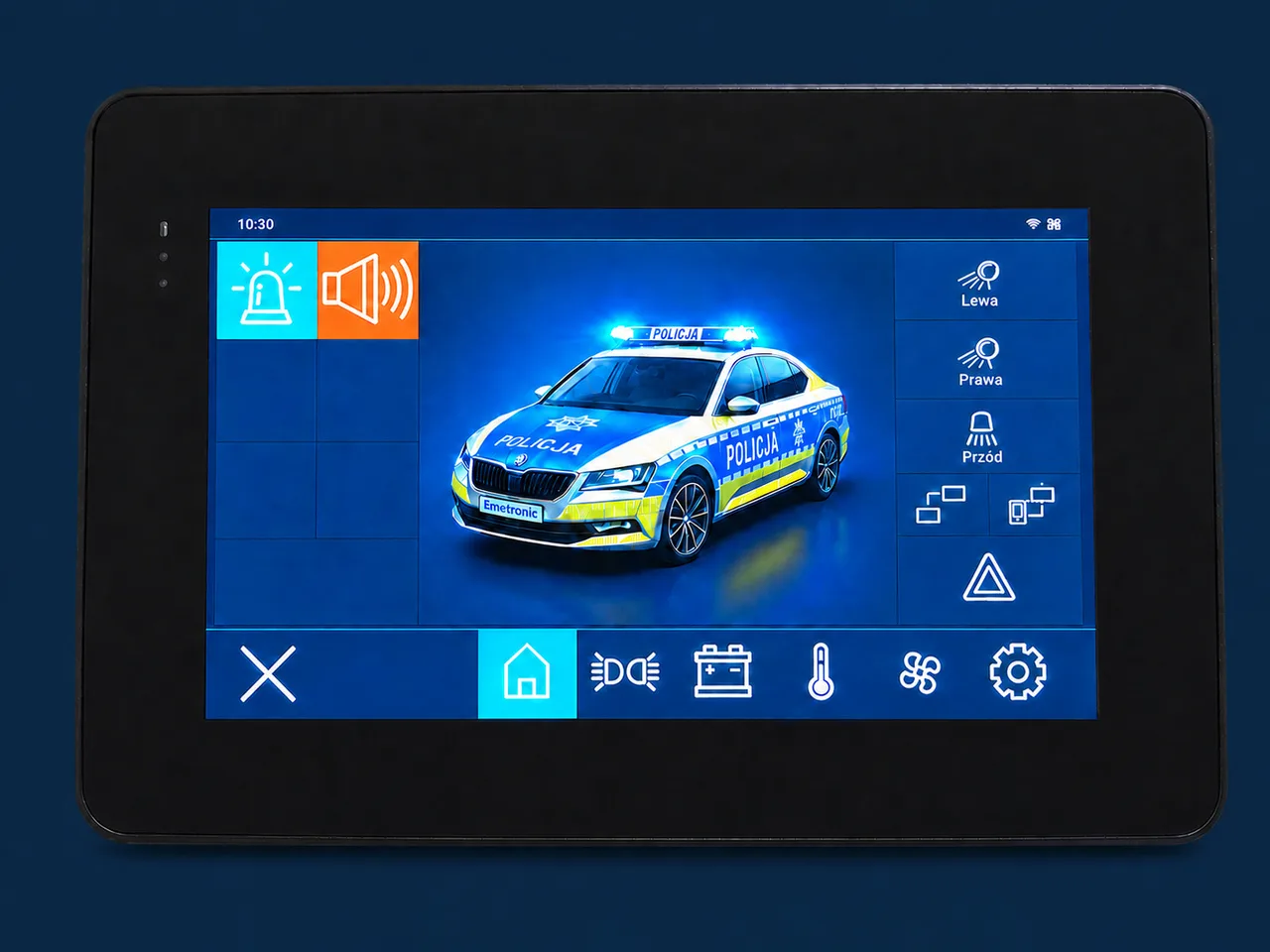
A touch panel controlling the whole vehicle
Signaling, lighting, power and temperature on one screen. Natively synchronised with EMCORE, not a universal off-the-shelf panel.
Read moreKnowledge base · 22 August 2026
What Regulation No. 65 is, what categories T, HT and X and classes 1 and 2 mean, how to read a type-approval mark, and what to ask a supplier before buying.
“R65 type-approved lamp” is one of the most abused phrases in the warning-signaling trade. Sometimes it stands for a full type approval — with a number, a certificate and an E mark on the housing. Sometimes it is only the seller's assurance that “the lamp meets the requirements”. For a special-vehicle upfitter the difference is fundamental: it is the upfitter who answers to the end user — the fire service, the police, a road authority — for the signaling on that vehicle being both legal and effective.
UN Regulation No. 65 lays down uniform provisions for the approval of special warning lamps for motor vehicles and their trailers — lamps emitting intermittent blue or auto-yellow light, and in defined cases red, fitted to emergency, special-purpose and slow-moving vehicles. The regulation operates under the 1958 Geneva Agreement administered by the World Forum WP.29 at the United Nations Economic Commission for Europe, and it is the basic document defining the parameters of such lamps in Europe.
R65 defines primarily:
Successive supplements extend the scope of the regulation, among other things to lamps with magnetic mounting. A detail that causes recurring confusion: R65 formally remains in its original series of amendments, which is why approval numbers begin with “00”. This is not an error in the document — the marking indicates the series of amendments, while later technical changes are introduced by supplements.
In Poland the obligation to use type-approved warning lamps follows from the Road Traffic Act, which prohibits fitting equipment and parts that do not meet the conditions laid down in the regulations, and from the rules on the technical conditions of vehicles. In tender practice the R65 requirement — often with a specific category and class named — appears in virtually every technical specification for fire-service, police, ambulance and road-service vehicles.
The category describes the area within which the lamp must achieve the required photometric values. It is the first parameter to match to the device's function on the vehicle.
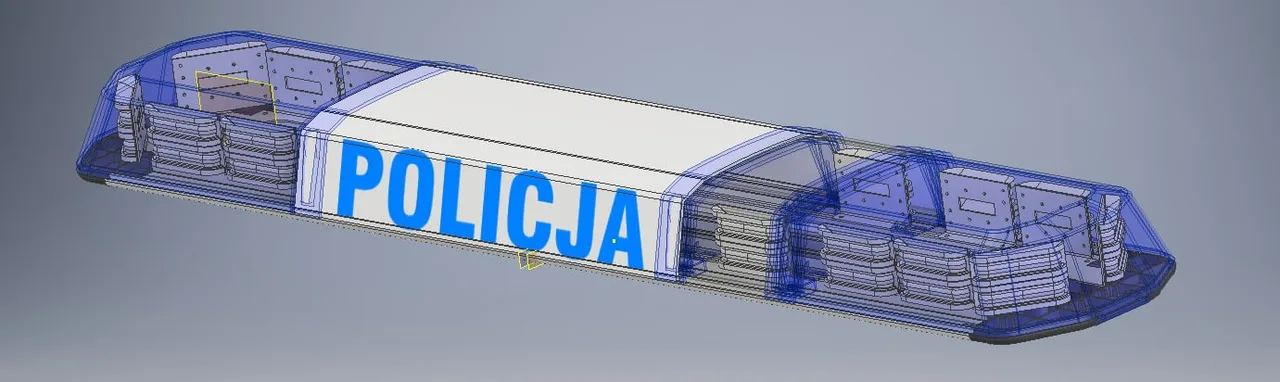
The lamp emits intermittent light through a full 360° around its vertical axis. This is the classic beacon — for example the PULSAR roof beacons — but also a complete light bar, which the regulation may treat as a single all-round device made up of several optical assemblies: in the Emertronic range, REMEDY TRI-LITE.
HT (half-T) denotes a device made up of one or more optical assemblies emitting intermittent light from 135° to the left to 135° to the right of its horizontal axis of reference. It therefore covers 270° in total and is intended for mounting at the front or the rear of the vehicle.
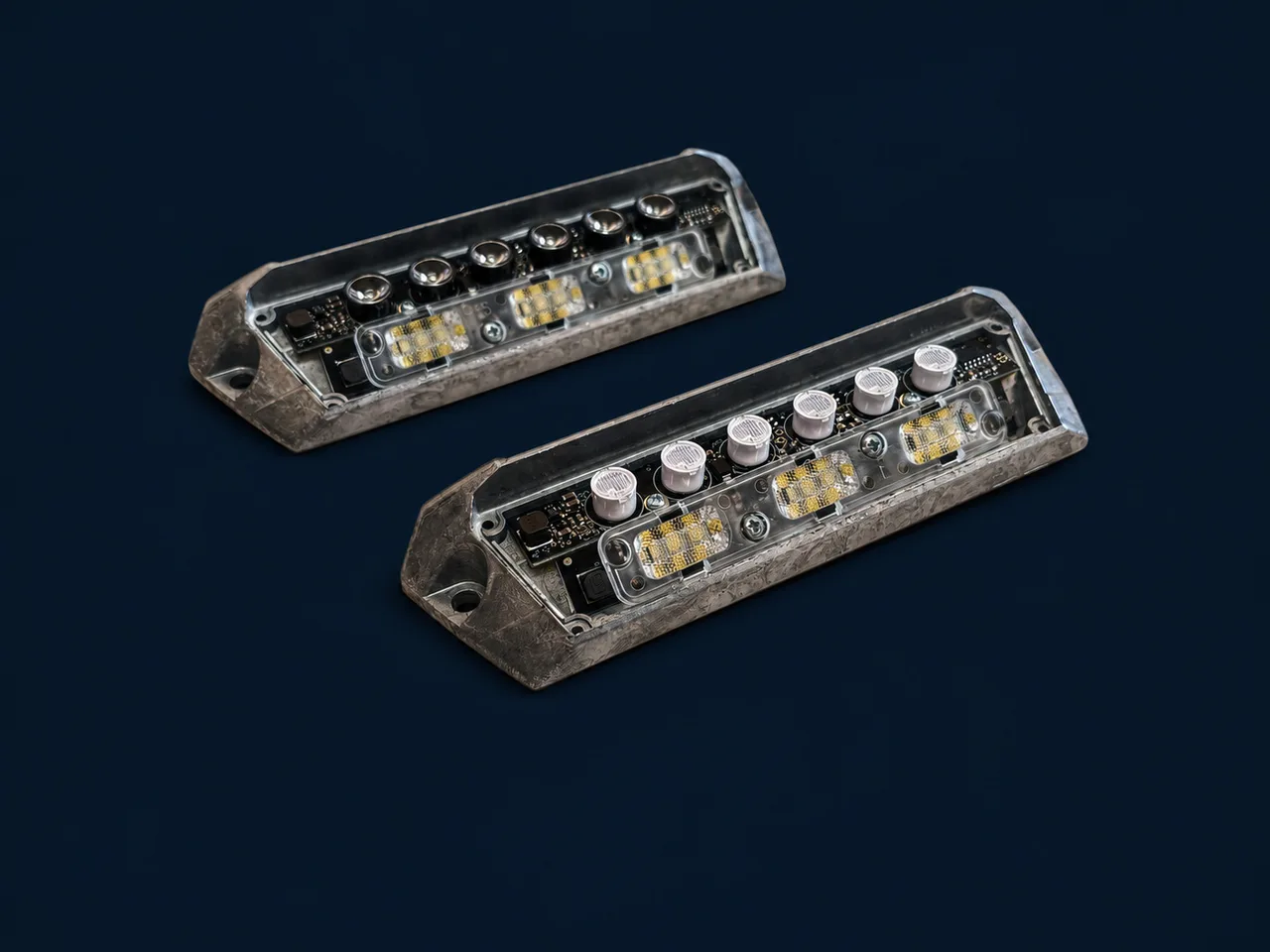
An approved HT type may consist of several separate units. Their geometry, relative position and maximum permitted spacing then follow from the approval documentation and the manufacturer's instructions. Not every arbitrarily assembled pair of lamps becomes an HT device. An example from the Emertronic range is the INFRAME corner lamp with HTB2 approval — one unit covers 270°, a pair gives a full 360° without a roof beacon.
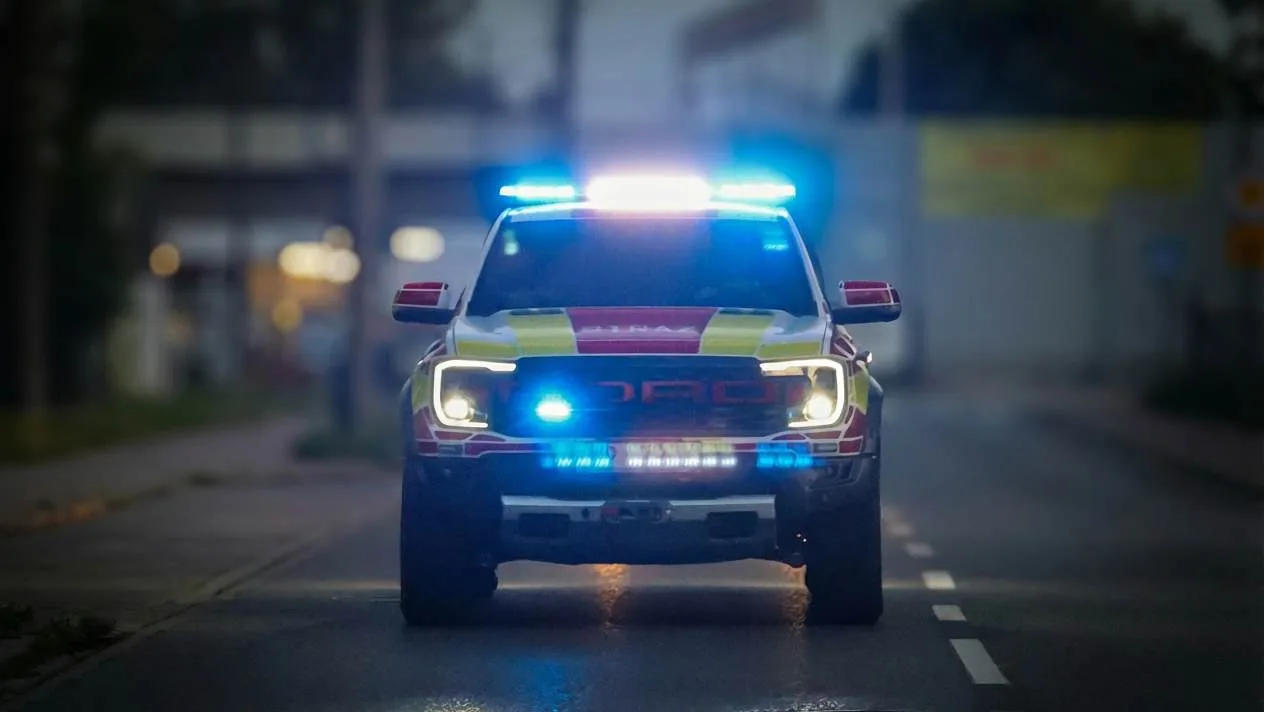
The lamp emits light within a limited angle and in one direction. These include front and rear lamps fitted in the grille, on the bonnet or on the rear wall of the body — in the Emertronic range, the XPULSE lightheads. They serve a supplementary role: they increase the penetration of the signal in a specific direction, for instance into the mirrors of the vehicle ahead, but on their own they do not replace the required all-round signaling.
The class describes the level of effective intensity (Je) — a photometric parameter that accounts for the fact that the eye perceives flashing light differently from steady light.
Class 1 covers lamps with a single intensity level. They must meet the photometric requirements for the night level only.
Class 2 covers lamps with two intensity levels. They must meet both the night requirements and the considerably higher day requirements, and must be able to switch level in day/night mode. As a result the signal stays legible in bright sunshine while not dazzling other road users at night.
Regardless of class, the flash frequency must fall within 2–4 Hz. The regulation also defines the light-on and light-off times precisely, along with the measurement conditions — among them 90%, 100% and 115% of rated voltage.
In practice, class 2 is today the expected standard in specifications for blue signaling on emergency vehicles. A class 1 signal on a fast road in bright sun is simply not enough. In the amber segment class 1 still dominates, but a growing group of buyers — road-maintenance services and escort operators for abnormal transport among them — deliberately require class 2 precisely for daytime visibility.
The colour of the light is encoded by a letter:
Red is permitted by the regulation, but its use depends on national law. In Poland an additional red flashing light is used on emergency vehicles at the head and at the tail of a column of emergency vehicles.
A complete type-approval marking on a lamp consists of three elements:
Besides the approval mark, the device must carry durable and legible markings: product type, manufacturer's name, rated voltage and power. The absence of any of these on a product sold “with type approval” should immediately set off a warning light — this time for the buyer.
Type approval is not a marketing claim but an administrative procedure. Representative samples of the lamp are tested by an authorised technical service: photometry on a goniophotometer, colorimetry, flash-frequency measurement and the rain test. On that basis the approval authority issues a numbered certificate, and the manufacturer undertakes to maintain Conformity of Production (COP) — that is, to ensure every subsequent unit leaving the line matches the tested type.
That is precisely why obtaining and maintaining approval costs real money — and why an approved lamp cannot compete on price with an unbranded equivalent that never went through those tests.
Equally important is what R65 approval does NOT cover:
At Emertronic we treat the R65 requirements as the minimum from which design starts — not as a goal in itself. We develop and test our products in our own laboratory, using among other things a goniophotometer for photometric measurements and a GTEM cell for EMC testing. Production runs entirely in-house, which lets us genuinely control the conformity of every batch with the tested type.
We provide approval documents for individual products on request, and we help select components when analysing a tender specification — get in touch. Every warning lamp offered by Emertronic under Regulation R65 is available exclusively in the highest, second intensity class.
No. CE is a declaration of conformity with EU directives, for example on EMC or RoHS, and it does not confirm the photometric parameters of a warning light. Legal use on public roads requires type approval under R65.
R65 covers the light parameters of a warning lamp — colour, intensity, distribution and flash frequency. R10 covers electromagnetic compatibility. A professional lamp intended for a special vehicle should hold both approvals.
The regulation itself does not assign classes to vehicle types — buyers' specifications and market practice do. And they do so unambiguously: for any signaling, the expected standard is class 2.
The reason is physical, not formal. Class 1 provides an intensity sufficient only in night conditions. In daylight — in full sun, against a bright sky, in reflections off wet asphalt — a class 1 lamp simply disappears into its surroundings. And an emergency vehicle does not choose the hour of its call-out: its signaling has to work in all conditions, or it does not do its job. A lamp that is effective “only at night” is a lamp that is half effective.
The consequence is graver than it looks. Signaling that cannot be seen is not “weaker signaling” — it is a false sense of safety. The driver runs on lights convinced of being visible and commits to manoeuvres the other road users are not prepared for, because they never saw the vehicle. A car meant to warn becomes an additional hazard itself — to its own crew and to everyone around it.
That is why class 2 — with day/night switching: full intensity by day, reduced at night so as not to dazzle — is the only sensible choice for an emergency vehicle. Class 1 has its uses, but where work happens at night or in low ambient light — not where someone's life depends on the vehicle being seen.
No. A category X lamp does not provide all-round visibility. Primary signaling is delivered by a category T device or by a properly designed arrangement of HT devices, consistent with the approval documentation and the manufacturer's installation instructions. Category X lamps play a supplementary role.
An engineer, not a call center. We answer specifically, with regulation numbers.