PROTOTYPEWork in progress
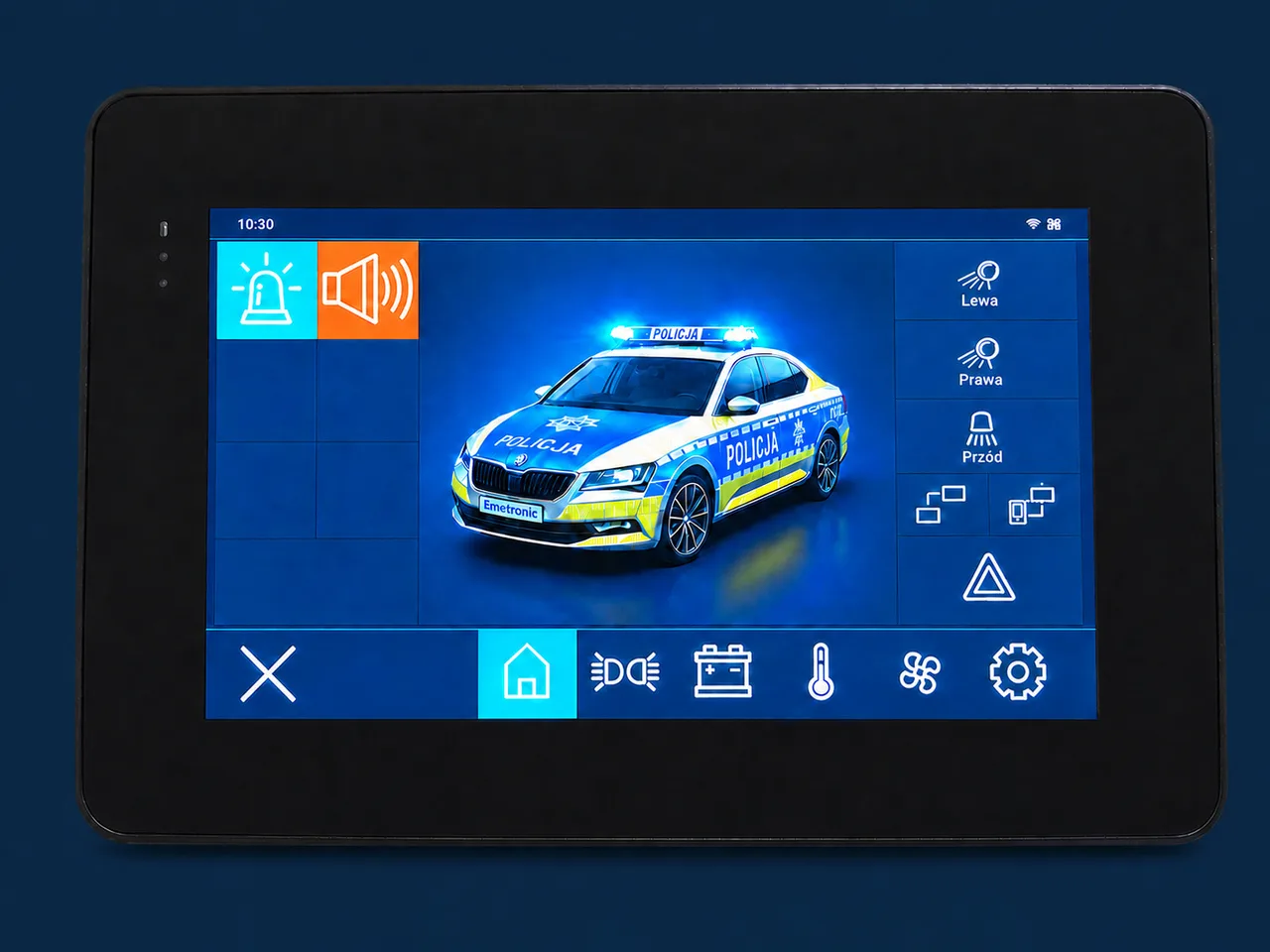
A touch panel controlling the whole vehicle
Signaling, lighting, power and temperature on one screen. Natively synchronised with EMCORE, not a universal off-the-shelf panel.
Read moreKnowledge base · 23 August 2026
Photometric approval is only half the story. The other half is Regulation No. 10 — electromagnetic compatibility, meaning whether a device disarms the vehicle's communications, and whether it can itself be disarmed.
In the article on ECE R65 we wrote that photometric approval is only half the story — the other half is UN Regulation No. 10 on electromagnetic compatibility (EMC). In no market segment does this matter more than in emergency and special-purpose vehicles: the radio, the status terminal, navigation, cameras, a dashcam and the warning signaling all work side by side within a few square metres of sheet metal. A device that jams communications in that environment — or that can itself be jammed — is a real operational hazard, however well it may flash.
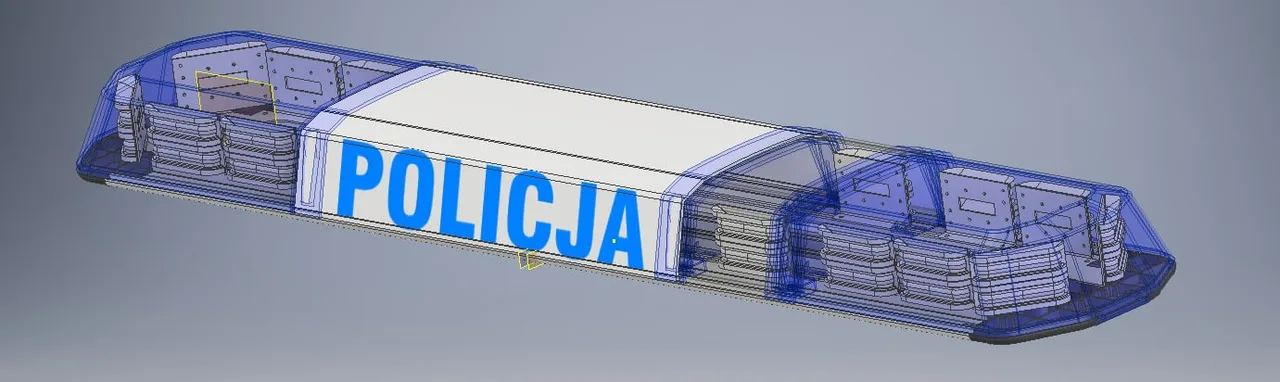
UN Regulation No. 10 lays down uniform provisions for the approval of vehicles with regard to electromagnetic compatibility. It covers complete vehicles and — crucially for our trade — electrical/electronic sub-assemblies (ESAs), that is, devices intended to be fitted in a vehicle. A light bar, a directional lamp, a siren amplifier or a signaling controller are exactly such sub-assemblies.
The regulation is developed through successive series of amendments — series 06 currently applies — and it is the series number, alongside the mere fact of holding an approval, that is often quoted directly in tender specifications (“meets the requirements of UNECE Regulation No. 10, series … or later”).
EMC has two sides and R10 covers both. First, emission: the device must not interfere with anything around it. Second, immunity: the device must work correctly in the electromagnetic field produced by other devices and transmitters.
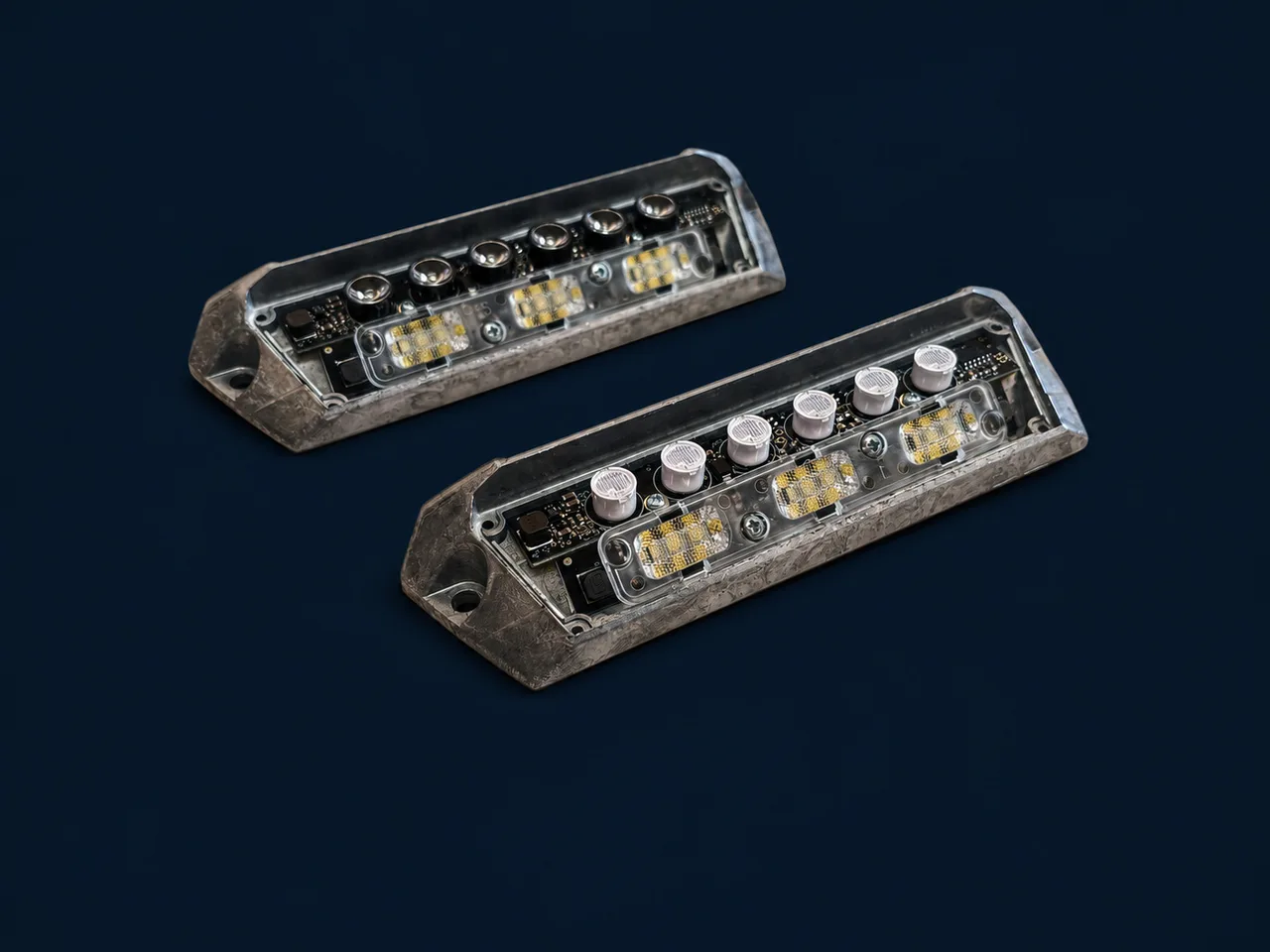
A modern warning lamp is, as a rule, switching electronics: converters driving the LEDs, controllers, communication between modules. Badly designed, each of these becomes an unintended transmitter of interference — radiated into the air and conducted into the on-board wiring. The regulation sets reference limits for broadband and narrowband radiated emission measured under laboratory conditions, together with requirements for disturbances injected into the vehicle's electrical system.
In a service vehicle the stakes are concrete: the band in which a cheap LED converter “hisses” can overlap with radio communication frequencies. Every fleet technician knows the effect — interference on the radio appearing at exactly the moment the signaling is switched on. That is not a cosmetic flaw but a disqualifying one.
The other side of the coin: on the roof of the same vehicle, often tens of centimetres from the bar, sits the antenna of a high-power transmitter. Add to that the transients in a 12/24 V system — pulses accompanying cranking, switching of inductive loads or battery disconnection. Immunity testing under R10 verifies that under such conditions the device does not go dark, does not change its operating mode by itself, does not hang the controller and does not need a restart — the reference levels for sub-assemblies reach fields on the order of 30 V/m across a wide frequency range, and immunity to conducted disturbances is checked by separate pulse tests on the supply lines.
For emergency signaling this requirement is existential: a lamp that goes dark while the radio transmits stops doing its job at exactly the moment it is needed most.
R10 does not treat all sub-assemblies alike. Full immunity testing applies to devices performing what the regulation calls immunity-related functions — those whose disturbance has a bearing on safety: direct control of the vehicle, protection of persons, and functions whose malfunction misleads the driver or other road users. Warning signaling falls squarely within that logic — an emergency lamp that flashes falsely, goes dark or changes mode confuses everyone around it. When buying signaling, it is therefore worth expecting that the manufacturer treated it in testing as a critical device, not as glovebox lighting.
There is also a purely formal dimension. The base vehicle leaves the factory with an approval covering electromagnetic compatibility. The regulation provides a simple route for retrofitting: a sub-assembly that itself holds R10 approval and is installed in accordance with the conditions defined for it does not require additional testing of the whole vehicle. In other words — a lamp with R10 approval slots into the vehicle's chain of conformity, while a device without one leaves a hole in that chain, and the person who fitted it answers for it.
On the device, R10 approval appears as a mark: the letter E in a circle with the number of the granting country, plus a number containing the regulation and amendment-series designation — hence the familiar string beginning “10R-06…”.
As with R65: type approval means testing representative samples at an authorised technical service, a numbered certificate and an obligation to maintain Conformity of Production (COP). And as there, R10 has a strictly defined scope. It says nothing about light parameters (that is R65), about sealing, mechanical resistance or durability. That is why the minimum complete set for a warning lamp is both approvals at once: R65 confirms the lamp warns effectively, R10 that it does so without disarming the vehicle's electronics and communications.
A short checklist for buyers:
Electromagnetic compatibility cannot be “added” to a finished product — it is decided in the first weeks of a project: converter topology, ground routing, shielding, supply filtering. That is why at Emertronic we run EMC testing in our own laboratory from the development stage — a GTEM cell lets us catch and eliminate emission and immunity problems on prototypes, long before the approval tests at a technical service. This applies both to lamps and to the electronics that is most demanding in this respect, such as the EMCORE siren amplifiers.
We provide approval documents for our products on request, and when analysing a tender specification we help verify whether the offered devices meet the series and ranges named there — just get in touch.
No. These are two separate regulations, separate tests and separate certificates. A professional signaling device should hold both.
That the device holds approval under Regulation No. 10 granted in accordance with the 06 series of amendments — the rest is the approval number. Next to it sits the letter E in a circle with the number of the country whose authority granted it.
No, provided the fitted sub-assembly itself holds R10 approval and is installed in accordance with the conditions defined for it by the manufacturer. The problem starts with devices that have no approval.
No. Equipment fitted in road vehicles follows the type-approval route — the CE mark from the general directives does not replace it.
An engineer, not a call center. We answer specifically, with regulation numbers.